Iran’s government said on Tuesday it could not say when the country’s 82-day internet blackout would end, as new data showed the shutdown has cost the economy more than $1 billion and a tiered access system has emerged that critics say gives internet to officials and professionals while cutting off ordinary citizens.
Government spokesperson Fatemeh Mohajerani, responding to questions about when international internet access would be restored, said the administration of President Masoud Pezeshkian opposed restrictions on internet use but could not provide a timeline.
“With the mandate the president has given (Iran’s First Vice President Mohammad Reza) Aref, we are trying, while taking into account all existing issues, the wishes of the supreme leader and the relevant considerations, to untie the knots around the internet so that we can arrive at a fairer situation,” she said.
International internet access was severed roughly an hour after the joint US-Israeli strike on Iran on 28 February, following a blackout previously imposed by the Tehran regime as part of the crackdown on country-wide anti-austerity protests that reached their peak in January.
More than 82 days later, most Iranians cannot access global platforms. A small number have maintained access through three mechanisms that critics say have hardened into a class system.
Three tiers of internet
At the top is what Iranians call “white internet” — unfiltered access that senior Islamic Republic officials have long used and which was gradually extended during Hassan Rouhani’s presidency to journalists whose names were submitted to the Ministry of Culture and Islamic Guidance.
Reza, a journalist in Tehran, said he has had white internet since 2018 and faced no disruption during the complete internet shutdown of November 2019 either.
Mansour Beytaf, former editor-in-chief of the economic daily Taadol, said he refused to hand over his personal phone number to obtain the privilege.
“Free access to the internet is a public right. You cannot give that privilege to some and deny it to others. It is blatant discrimination,” he told Euronews.
Below white internet sits “Internet Pro” — also marketed as “stable business internet” — which provides selected categories of users, including registered companies, journalists, lawyers, academics and medical professionals, with limited access to a capped list of international platforms, typically no more than 10.
Access to Telegram and WhatsApp is generally stable for Internet Pro users, while Instagram, YouTube and X are unreliable.
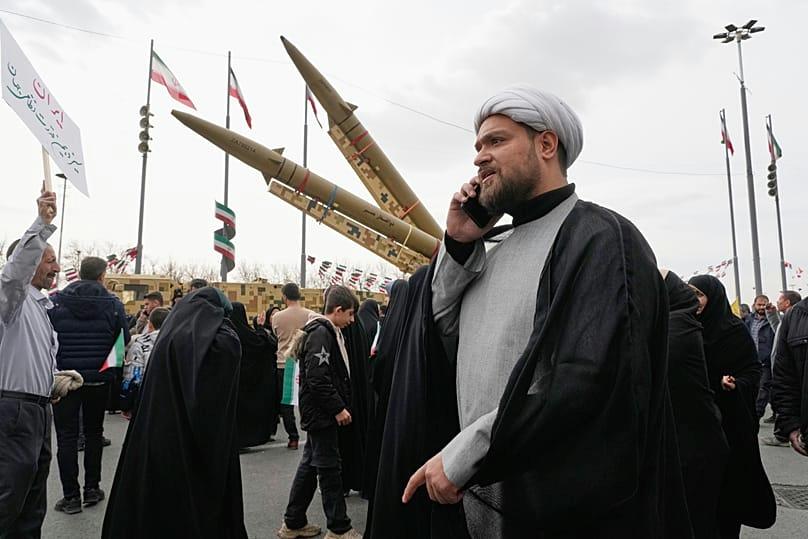
FILE: A cleric talks on his phone as he walks in front of missiles during an annual rally marking 1979 Islamic Revolution at the Azadi Square in Tehran, 11 February 2026
The tier structure tightens further for specific professions. University lecturers are largely confined to academic databases and Google Scholar. Doctors have access mainly to WhatsApp.
Internet Pro costs 40,000 tomans per gigabyte — roughly €0.20 at current exchange rates. Those without it are paying around 500,000 tomans per gigabyte for commercially available VPNs, more than 12 times as much.
Alireza, a 40-year-old café owner in Tehran who does not qualify for Internet Pro, said he spends 15 million tomans — around €75 — a month to maintain 1 gigabyte of daily VPN access, a sharp reduction from the unlimited browsing he previously used for business.
“In which country does using the internet cost this much?” he told Euronews. “Just because there’s a war on, should the Iranian people be deprived of the internet?”
The economic toll
Abbas Ashtiani, head of the blockchain commission at the national IT guild organisation, told state agency IRNA in late April that the internet outages had inflicted around $1 billion (€862 million) in damage on Iran’s digital economy over the first 50 days of the shutdown — including direct losses, lost profits and other harms.
He put daily losses at between $30 million and $35 million (€26.8 million and €30 million).
Beytaf told Euronews that by mid-May, and without counting indirect losses, the shutdown had caused businesses 16.3 trillion tomans (€181 million at official market rates) in lost profits.
Those hardest hit have been sellers who ran businesses on Instagram, WhatsApp and Telegram — many of them informal traders who do not qualify for Internet Pro and cannot afford VPN costs.
Digikala, one of Iran’s largest e-commerce platforms, has laid off staff due to reduced turnover.
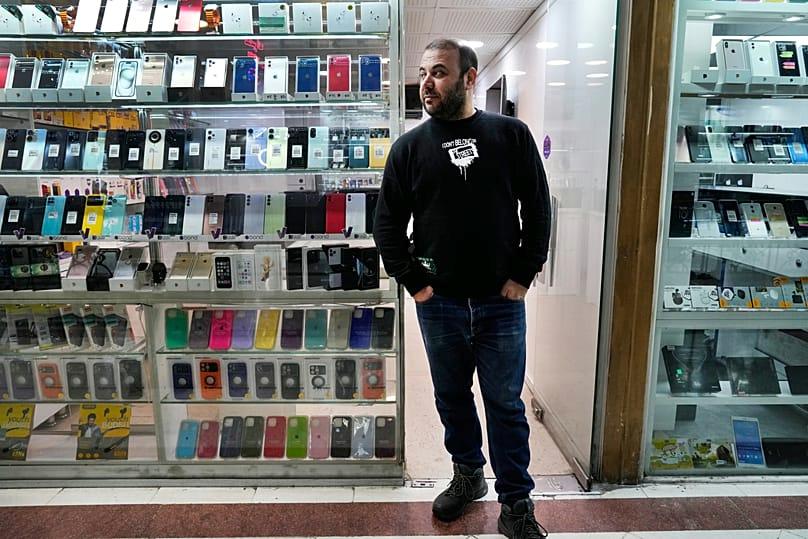
FILE: A worker at a mobile phone store waits for customers in downtown Tehran, 21 February 2024
Mohajerani said on Tuesday that Internet Pro was designed for businesses and was not intended as a general solution to internet shutdowns.
She described the government’s position as opposing all discrimination and regarding internet access as a right for all citizens.
Critics have noted a contradiction at the centre of the government’s position: Pezeshkian chairs both the government, which says it opposes discrimination, and the Supreme National Security Council, which approved the Internet Pro system.
The answer, analysts inside Iran suggest, lies in the Islamic Republic’s dual sovereignty structure, in which the president does not hold ultimate executive authority — making his stated opposition to the tiered system largely symbolic.



 News
News
 Dünya
Dünya
 Dünya
Dünya
 Dünya
Dünya
 Dünya
Dünya
 Dünya
Dünya
 Dünya
Dünya