The US blockade of Iranian ports appears to be holding steadily since it came into force, while Iran’s continuing cutoff of the vital oil and gas shipments waterway holds tankers blocked outside the strait and maritime traffic at minimal levels, according to multiple maritime data observations by Euronews on Friday and over the last days.
In its last blockade update on Wednesday, the US Central Command said no ships have breached the US blockade since it was implemented on 13 April, while ten merchant vessels complied with direction from US forces to turn around and re-enter Iranian waters.
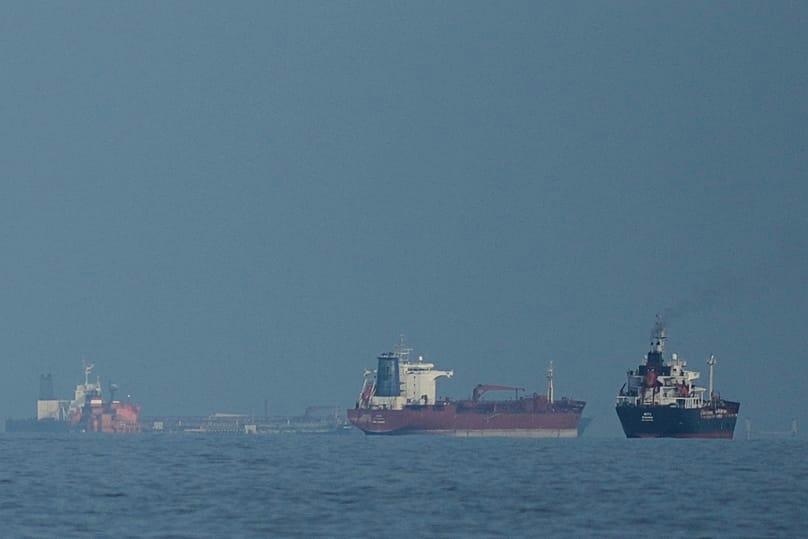
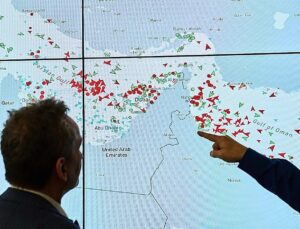
Tankers and other ships are now piling up into a giant parking space outside the strait all the way to Dubai and other UAE ports, Euronews journalists in Dubai reported, while Iranian ports show minimal sign of movement, according to maritime traffic data.
US President Donald Trump announced on Thursday that he would extend the Iran ceasefire if needed underlining a renewed momentum, stating that “I think we have very successful negotiation going on right now, and I think it’ll be, if it happens, it’ll be announced fairly soon and that’ll give us free oil, free Hormuz Strait. Everything will be nice.”
The United States enforced the blockade to pressure Iran to lift its own closure of the strait and to stop its multi-million barrels, sanctions-evading oil shipments to Asia by so-called dark transits, when vessels switch off their transponders to avoid detection. Tehran’s decision to effectively close the waterway to pressure the US and Israel to stop their attacks sent shockwaves through energy markets with far-reaching consequences to global economies, with each day adding even more pressure to markets.
The complexity of the navigation technicalities through the US blockade is adding to the confusion in the strait, with oil tankers in Iranian ports being blocked, but some other shipments being exempt, including cargo designated as humanitarian shipments, as per a CENTCOM notice to mariners.
Therefore, according to the Washington-based Institute for the Study of War think tank, maritime data showed that at several vessels entered the Strait of Hormuz, including three Iranian or Iranian-linked vessels, on 14 April.
One of the entering vessels was the Ocean Energy cargo ship, which docked at Iran’s Bandar Abbas Port on April 13. It is unclear whether this vessel was exempted from the blockade, the ISW said.
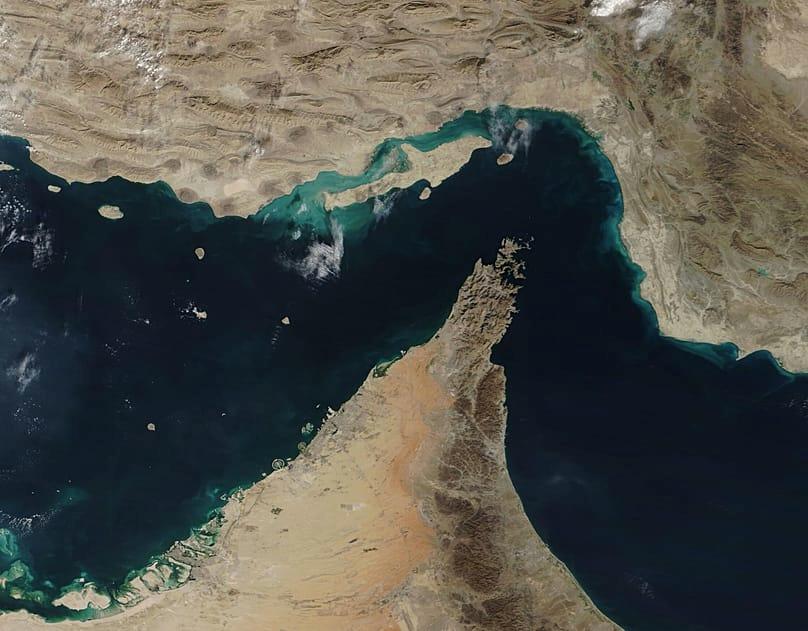
A satellite picture of the Strait of Hormuz, 2 December, 2020
According to the Washington-based Institute for the Study of War think tank, the complexity and variety of factors involved in the blockade, including determining vessels’ origin and destination and whether vessels are considered “neutral,” make it premature to try to assess whether some vessels have gotten through the US blockade.
CENTCOM said the blockade is being enforced “impartially against all vessels of all nations entering or leaving coastal areas or ports in Iran,” while vessels avoiding Iranian ports are not affected.
To show how the blockade works, CENTCOM released an audio file of a warning from a sailor aboard the USS Michael Murphy warship with video from the guided-missile destroyer’s embarked helicopter flying over the Gulf of Oman.
Admiral Brad Cooper, head of US Central Command, announced on Thursday that “US forces have completely halted economic trade going in and out of Iran by sea,” as more than 10,000 American troops, over 12 ships and more than 100 aircraft are enforcing the blockade on Iranian ports and that no ships have yet needed to be boarded.
The commander of Iran’s joint military command, Ali Abdollahi, threatened to halt all trade in the region if the US blockade which it considers a violation of the ceasefire.
Other Iranian officials warned that Iran may now block shipping through the Red Sea and block the Bab al-Mandab strait, as the US blockade is exerting a growing pressure on Iran’s much-needed oil shipments that sustain its beleaguered economy. The US blockade of Iranian ports also means that Iran’s plans to charge payments for Hormuz transit are now effectively on hold, with no revenue streaming in.
Meanwhile on Thursday, China’s UN ambassador Fu Cong called the US blockade “a dangerous and irresponsible move,” adding that the strait “should be safeguarded” for international navigation, while calling on Iran to take “proactive measures” to open the waterway.
Earlier in the day, in a social media post, US president Trump said China had agreed not to provide weapons to Iran as reports circulated that Beijing has considered transferring arms. China’s Foreign Ministry denied the reports.
Oil tankers and cargo ships line up in the Strait of Hormuz as seen from Khor Fakkan, 11 March, 2026
China has long supported Iran’s ballistic missile program and backed it with dual-use industrial components that can be used for missile production, according to the US government.
On Thursday, the US military released an expansive list of goods it considers contraband as part of its blockade stating that any “goods that are destined for an enemy and that may be susceptible to use in armed conflict” are “subject to capture at any place beyond neutral territory.”
The list includes items like arms, ammunition and military equipment that are classified as “absolute contraband.” However, it also lists items like oil and iron, steel, and aluminium as well as some civilian goods, as “conditional contraband” and argues these items can be put to military use.
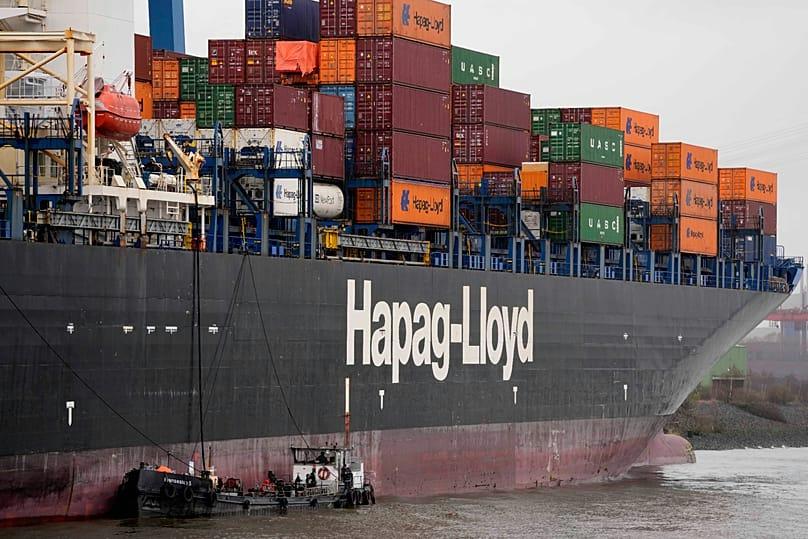
As to the sailors blocked in the standoff, Germany’s largest shipping company Hapag-Lloyd says it’s feeling the impact of the blockade of the Strait of Hormuz as 150 sailors are trapped there on six of its vessels.
The Hapag-Lloyd container ship ‘Chacabuco’ from Monrovia is docked in Hamburg, 31 March, 2023
“Five and a half weeks in a war zone — that’s something relatively new. And of course, these are difficult days and weeks for our colleagues,” Hapag Lloyd spokesperson Nils Haupt told The Associated Press news agency.
“We’ve been able to rotate some of them in the meantime, but you can easily imagine that after such a long time, monotony naturally sets in on board and the most important thing now in this situation is to maintain that team spirit,” he added.
Hapag-Lloyd is in contact with the captains and crews at least once a day asking how the crew is doing and what they can do to help, adding that thanks to modern satellite technology, the sailors are able to keep up communication with their families.


 News
News
 Dünya
Dünya
 Dünya
Dünya
 Dünya
Dünya
 Dünya
Dünya
 Dünya
Dünya
 Dünya
Dünya
 DÜNYA
DÜNYA