For almost two years, Ukraine’s ambition to one day join the European Union has been defined not by its progress but by its lack thereof.
Hungary’s veto, imposed in June 2024 and since entrenched, has effectively paralysed Ukraine’s membership application, pushing Kyiv and Brussels towards informal avenues to advance the legal and technical work in the hope of a breakthrough.
As a result, Ukraine today finds itself in a highly unusual position: on paper, it is ready to open the six clusters of negotiations that structure the accession process, but in practice, it is unable to open any of them.
Exasperation is palpable among Ukrainian and European officials, who believe the veto is disproportionate, unjustified and downright abusive.
Now, after the bruising defeat of Hungarian Prime Minister Viktor Orbán in the April elections, the EU has been given the first credible chance to break the deadlock and fulfil the promise made to Kyiv in the early months of Russia’s all-out war.
Brussels expects Orbán’s successor, Péter Magyar, to swiftly end the constant obstruction and allow the gradual opening of the clusters. The goal is to, at least, open the first one, known as “fundamentals”, before the summer break.
But if the change of guard in Budapest is filling leaders with hope and relief, it is also forcing them to confront the complex, sensitive questions surrounding Ukraine’s accession that the Hungarian veto had effectively sidelined.
So far, the political debate has focused on Orbán, his obstruction and possible workarounds. After his departure, the core question – how to make Ukraine, a country under invasion, an EU member – comes to the fore.
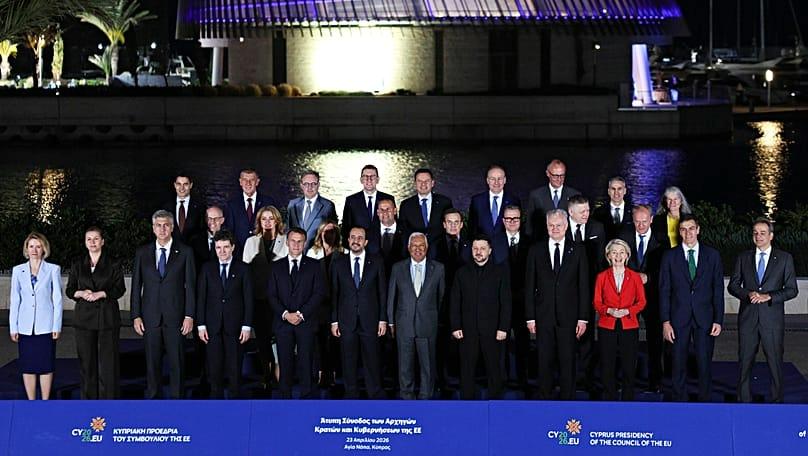
The new dynamic played out in full view during last week’s informal summit of leaders in Cyprus. Ukrainian President Volodymyr Zelenskyy, who was initially scheduled to intervene virtually, decided to appear in person to make the case for his country.
Zelenskyy joined EU leaders in Cyprus.
“We seek the same full membership that every EU nation has, from Cyprus to Poland. The only thing we ask is speeding up the full membership, with a clear start date for membership,” Zelenskyy told the informal gathering.
Leaders performed a delicate balancing act: they offered Zelenskyy warm words of support peppered with pointed caveats to manage his expectations.
“Negotiations on EU accession can proceed quickly, but that does not mean that an accession date for Ukraine can be named in the very short term,” said Dutch Prime Minister Rob Jetten, noting Kyiv “still has a lot of work to do”.
“Ukraine belongs to the European family, but on the way to membership, every country must comply with a certain number of conditions. That’s always been like that,” said his Luxembourgish counterpart, Luc Frieden. “There are no shortcuts.”
Belgium’s Bart De Wever was equally cautious. “I think there’s too much euphoria about the fact that Viktor is no longer there,” he told reporters.
Days later, German Chancellor Friedrich Merz poured more cold water on the impression that Orbán’s exit would roll the red carpet for Ukraine’s admission.
“Zelenskyy had the idea of joining the EU on 1 January, 2027. That will not work. Even 1 January, 2028, is not realistic,” Merz said.
Thorny questions
Handling Ukraine’s accession was always destined to be difficult.
Although it was World War II that planted the seed for the audacious project of European integration, the bloc has never dealt with a candidate still at war. There is simply no precedent in the lengthy rulebook to incorporate a country that is battling a full-scale invasion and has about 20% of its territory under military occupation.
Brussels has repeatedly touted EU membership as a security guarantee to protect Ukraine against a new Russian assault, while stressing that neither Moscow nor Washington is entitled to set the pace of enlargement.
Ukraine’s population size, vast territory, mounting reconstruction costs and powerful grain production all weigh heavily in the conversation, as its entry would likely trigger tectonic shifts in the two largest envelopes of EU funds: agriculture and cohesion.
Politically, there are concerns about the effects on decision-making if Ukraine, together with other candidates, joins the bloc in the near future. Orbán’s 16 years in power proved how far a veto can be stretched and how much havoc it can wreak.
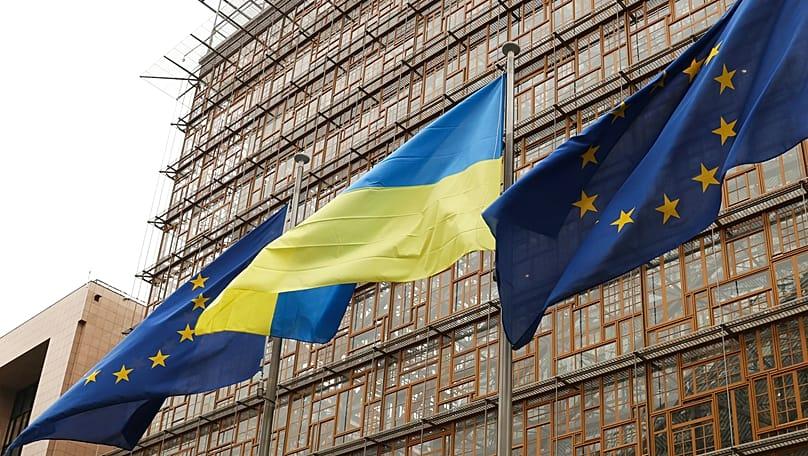
Ukraine was declared a candidate country in 2022.
These concerns could be addressed by amending the EU treaties and adapting internal rules to prevent undesirable surprises. But opening the treaties is like opening “Pandora’s Box”, diplomats warn, because you never know what might come out of it.
All these uncomfortable questions explain why EU leaders are so opposed to Zelenskyy’s two-fold request for an accelerated timeline and a specific admission date. After years of speaking in broad terms, the tone is turning more sober and businesslike.
Ursula von der Leyen, the president of the European Commission, said in Cyprus that accession was a “two-way contract” between the candidate, which carries out reforms, and member states, which are meant to reward those efforts.
“In the very end, it is a political decision by all member states, because by unanimity, you have to then decide on accession,” she said. “But the way forward, the merits-based process, has to be respected for both sides to know what to rely on.”
By her side, António Costa, the president of the European Council, rebuffed “artificial” deadlines and urged countries to act with a “sense of urgency” and “be creative”.
Outside the box
Several creative solutions have already been floated.
Earlier this year, the Commission pitched a “reversed” process under which Ukraine would become a member in name and gradually obtain the associated benefits. Capitals shut down the plan in March, dismissing it as reckless.
In Cyprus, De Wever spoke of a “multi-layered” Europe to integrate candidates at different speeds, and Merz suggested Ukraine could join the institutions without voting rights. Similar ideas envision bringing Ukraine deeper into the single market so it can feel economic benefits as it continues the arduous work on the clusters.
Officials and diplomats in Brussels have different views on the matter but largely agree that any proposal must be workable and reasonable and keep Kyiv’s hopes alive.
Zelenskyy says he is willing to discuss “possible formats” to accommodate his country’s ambitions but insists he will not settle for anything “symbolic”.
“Ukraine is defending itself and is definitely defending Europe. And it is not defending Europe symbolically – people are really dying,” he said before flying to Cyprus.
Complicating matters is the uncertainty over Péter Magyar’s approach. While campaigning, Magyar rejected fast-tracked membership for Kyiv. Later, he publisheda long list of actions that Ukraine should take to “improve the situation” of the Hungarian minority in Transcarpathia, an issue that Orbán previously used against Zelenskyy.
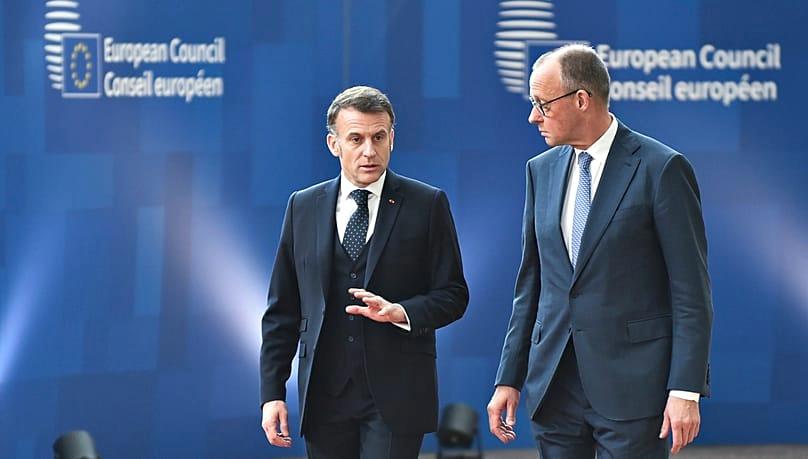
Emmanuel Macron and Friedrich Merz.
On top of that, next year’s calendar is packed with high-stakes elections in four of the five largest member states – France, Italy, Spain and Poland – that could see Eurosceptic forces exploit enlargement to gain ground.
A 2025 Eurobarometer found that 52% of EU citizens were in favour of Ukraine’s admission and 41% were opposed, with stark variations between countries.
Scrutiny is particularly intense in France, where any new accession to the bloc would require approval either by popular referendum or a three-fifths majority in the National Assembly. The far right currently leads opinion polls.
The ongoing search for creative solutions can “provide tangibility without immediate full membership” for Ukraine and give leaders more time to build a “compelling case” among wary voters, says Vladislava Gubalova, a senior fellow at GLOBSEC.
“Political leaders are navigating increasingly difficult domestic environments, where pro-European messages for integration and enlargement are not met with unifying public support. On the contrary, voters – even when supportive of Ukraine – demand economic and social solutions at home,” Gubalova told Euronews.
“This, coupled with inadequate strategic communication on the benefits of enlargement and comprehensive domestic and foreign disinformation campaigns, leaves political leaders with a narrow path to manoeuvre.”


 News
News
 Dünya
Dünya
 Dünya
Dünya
 Dünya
Dünya
 Dünya
Dünya
 Dünya
Dünya
 Dünya
Dünya