As the world turns its gaze toward the Alpine horizons of Milano–Cortina 2026 Winter Olympics, we prepare to witness breathtaking feats of endurance and excellence amid snow and ice.
Italy will once again open its arms with its unmatched blend of culture, history, and warmth – transforming the Winter Games into a celebration not only of sport, but of shared humanity.
But this is a moment that calls for more than applause. It invites us to pause and ask a deeper question: why do the Olympic Games matter – especially now, when Europe and the world face one of the most dangerous periods in generations?
For many, the Games are thrilling entertainment, a source of national pride, a global celebration of human achievement, or an opportunity for revenues to broadcasters from corporate sponsors. All of this is true. But it is not their true legacy.
The Olympics were born as an institution of peace.
Long before modern stadiums and television audiences, the ancient Greek world was rich with athletic festivals such as the Pythian, Nemean, Isthmian, and Panathenaic Games. Yet one stood apart: the Games held at Olympia.
Their creation followed the counsel of the era’s moral compass – the wise women of the Oracle of Delphi – who urged rival city-states to bind athletic competition to a sacred peace pact.
Thus was born ekecheiria, the Olympic Truce.
Might bowed to shared values
Before each Games, heralds travelled across the Greek world announcing the suspension of hostilities. Armies halted their fighting. Travellers were granted safe passage. All who entered Olympia did so unarmed, stepping into holy ground where violence was forbidden.
For over a thousand years, this truce endured – the longest continuous peace arrangement in recorded history. And it was enforced.
When Sparta violated the Truce during the Peloponnesian War in 420 BCE, it was publicly condemned, fined, and barred from those Games. So even the strongest power of the time was not above shared rules of peace.
In that sacred moment, might bowed to shared values.
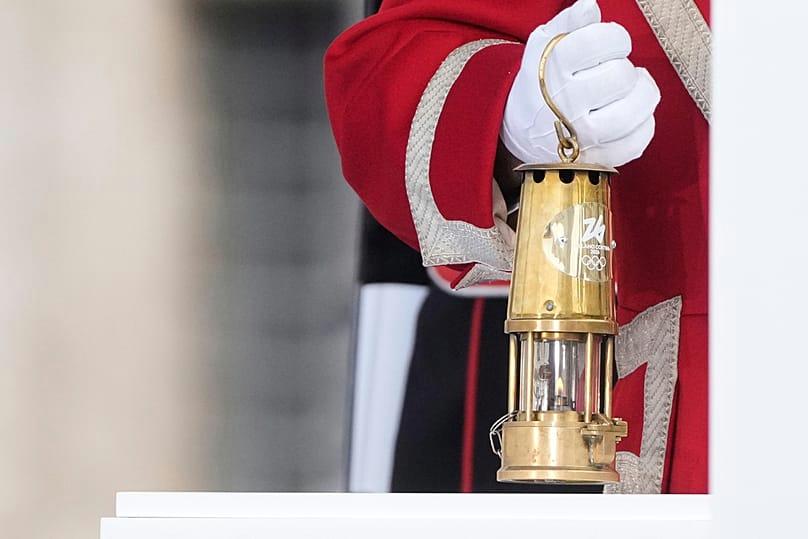
A cuirassier holds the torch lantern prior to the Milan Cortina 2026 Winter Olympics cauldron lighting, in front of the Quirinale Presidential Palace, in Rome, 5 December 2025
To understand the power of this idea, compare the Olympic Games to the Roman arena.
Both were spectacles – yet they represented opposite visions of civilisation.
The Olympics celebrated human excellence. Games of peaceful competition, artistic expression, human excellence and equality among free citizens were governed by rules ensuring fairness. Victors were crowned with olive wreaths, immortalised in poetry and sculpture.
The arena glorified domination and brute force. Slaves and prisoners fought for survival at the Emperor’s whim – his raised or lowered thumb deciding life or death – as we symbolically do on social media in today’s outrage-driven spectacles. Humanity was eclipsed by raw power.
The Olympics elevated peaceful competition, dignity, freedom and excellence. The arena exalted violence, control and dominance.
Two worldviews. But this is proof that humanity does have choices. We face those same choices today.
Do we celebrate human dignity – or brute force?
Do we channel power toward justice and cooperation – or toward dominance and hubris?
Europe now stands at that crossroads once again.
Not romanticism, realism
War has returned to the continent. Ukraine suffers brutal aggression. Gaza has descended into a humanitarian catastrophe. Violence continues across the Middle East.
Peaceful protest has been bloodily suppressed in Iran. Conflicts rage in Sudan and the Sahel. Great-power rivalry weakens international law and paralyses global institutions.
The promise of multilateralism – that rules and cooperation can restrain power – has frayed. A dangerous idea is re-emerging at the heart of global politics: that might makes right.
This is precisely the world the Olympic Truce was created to resist.
It reminds us that even amid fear and rivalry, humanity can choose restraint – that there must be spaces where weapons fall silent, enemies meet as human beings, and shared rules replace violence.
When the modern Olympics were revived in Athens in 1896 by Pierre de Coubertin, alongside Greek visionaries Demetrios Vikelas and Kostis Palamas, this ancient spirit was deliberately restored.
Influenced by classical philosophy and Enlightenment ideals, they envisioned the Games as a school of citizenship – a force for peace, education, and international cooperation in an interdependent world.
This was not romanticism. It was realism.
Shared experiences humanise rivals. Institutions of peace must be built – and continuously renewed. History bears it out.
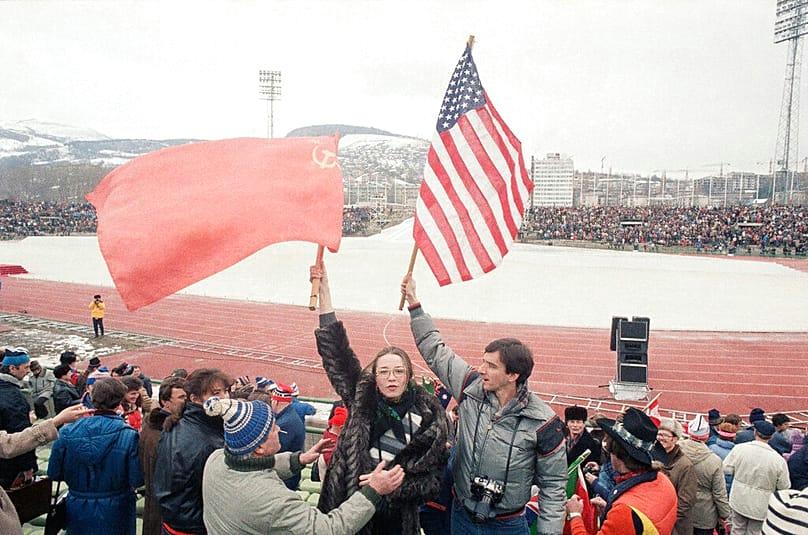
Spectators wave US and Soviet flags at the opening ceremony of Olympic XIV Winter Games at Kosevo Stadium in Sarajevo, 8 February 1984
During the Winter Games in Lillehammer, humanitarian corridors opened in besieged Sarajevo, allowing vaccines to reach tens of thousands of children.
Military confrontation was avoided between the US and Iraq during the Games in Nagano.
And during PyeongChang, steps to stop military exercises and open renewed dialogue were taken between North and South Korea.
These need to serve as lessons for today’s rivals.
And through the International Olympic Truce Centre in Athens, each Olympiad now integrates peace education, youth engagement, and cultural initiatives – keeping the Truce alive as a living practice, not a historical footnote.
No one who has governed in times of crisis believes that sport alone can end wars.
Yet without deliberate efforts to build a global culture of peace – through education, culture, cooperation, and shared experience – violence will increasingly become the default language of international affairs.
What kind of civilisation do we choose to uphold?
Our technological power has far outpaced our moral wisdom.
Climate change, mass displacement, inequality, pandemics, and the disruptive force of artificial intelligence cannot be solved through force or zero-sum politics. They demand collaboration, trust, and strong institutions of collective action.
Europe understands this truth in its bones.
Conceived from the ruins of two world wars, the European Union was never meant to be just a market or a set of faceless institutions.
It was conceived as a peace architecture, built on law instead of force, dialogue instead of domination, dignity, respect and shared prosperity instead of zero-sum power games.
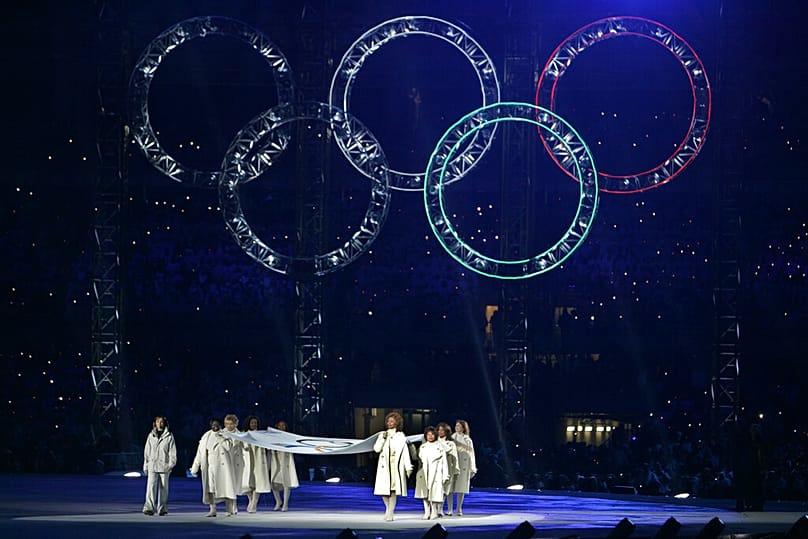
Italian actress Sophia Loren, right, leads notable women as they present the Olympic flag during the 2006 Winter Olympics opening ceremony in Turin 10 February 2006
At its heart lies a bold and revolutionary insight: that the immense power humanity has accumulated must be consciously restrained, guided, and governed – so it serves the common good rather than tears societies apart.
To abandon that legacy now would be to forget why Europe exists.
This is why Milano–Cortina matters far beyond podiums, awards and ceremonies.
It offers Europe a moment to reaffirm cooperation in a world sliding toward confrontation. Welcoming athletes from around the globe to European soil reminds us that competition need not breed hatred – that strength must be tempered by fairness, and that humanity prospers when rules replace violence.
The ancient Greeks proved that peace could be organised – that even bitter enemies could lay down arms and share sacred ground. The modern Olympics revived that bold experiment for a global age.
Today this experiment is more vital than ever.
Initiated by Italy and co-sponsored by 165 nations, the UN member states unanimously agreed on a call for all to observe the Truce for the Olympic Winter and the Paralympic Winter Games in Milano-Cortina, emphasising sport’s role in promoting peace, dialogue, tolerance, and reconciliation amid global conflicts.
As the world gathers in the Italian Alps for sport’s greatest winter celebration, we are once again challenged – not only to respect the Olympic Truce – but what kind of civilisation we choose to uphold: one governed by fear and force – or one guided by dignity, cooperation, and shared responsibility.
Milano–Cortina can be more than a spectacle. It can be Europe’s renewed call for peace, and conviviality in an age that desperately needs both.
George Papandreou is former Prime Minister of Greece (2009–2011) and President of the International Olympic Truce Centre.


 News
News
 Dünya
Dünya
 Dünya
Dünya
 Dünya
Dünya
 Dünya
Dünya
 Dünya
Dünya
 Dünya
Dünya
 DÜNYA
DÜNYA