After months of political gridlock, France’s 2026 state budget was definitively adopted on Monday evening, following the rejection of two no-confidence motions in parliament.
The motions were tabled in response to Prime Minister Sébastien Lecornu’s decision on Friday to invoke Article 49.3 of the constitution, which allows the government to pass legislation without a vote from MPs.
One motion was tabled by the far-right National Rally, the other by left-wing parties excluding the Socialists. Since both failed, the budget has been automatically adopted.
The vote marks the final chapter of a long and turbulent process that has highlighted deep divisions within France’s fragmented parliament.
Since snap elections in 2024 produced a hung assembly, lawmakers have repeatedly failed to reach a compromise on how to tackle the country’s deteriorating public finances. With no stable majority, Lecornu ultimately chose to force the bill through.
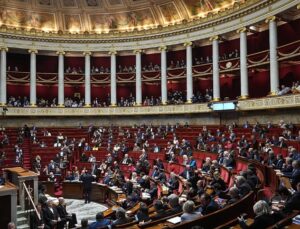
During the parliamentary debate on Monday, tensions ran high. Prime Minister Lecornu accused parts of the opposition of creating “permanent disorder”, arguing that blocking budget talks at such a moment was irresponsible.
The far-right National Rally, meanwhile, denounced what it called a “budget of punishment and deprivation”, urging lawmakers to vote to bring down the government.
Divisions within the government camp
The budget has not convinced all of the government’s allies. Several centre and right-wing lawmakers have openly questioned whether the target of reducing the public deficit to 5% of GDP in 2026 — down from 5.4% in 2025 — is realistic.
Under the government’s plan, businesses will shoulder several tax increases, including an extra levy on large corporate profits expected to raise more than €7 billion. The state deficit is forecast at around €132 billion, broadly unchanged from last year.
Agnès Pannier-Runacher, a lawmaker from President Emmanuel Macron’s camp, said the budget “does not prepare the future” and warned that higher taxes could hurt economic activity.
She argued that some companies have already frozen hiring while waiting for clarity on new fiscal measures.
A divided left, Socialists hold the balance
On the left, divisions remain sharp. The hard-left France Unbowed (LFI) and the Greens pushed hard for the Socialist Party to support a no-confidence vote.
However, the Socialists have made clear they will not back the motions, effectively guaranteeing the government’s survival. In return, they secured several concessions, the most symbolic being the suspension of the highly unpopular pension reform that would have raised the retirement age from 62 to 64.
The measure has been delayed until after next year’s presidential election.
LFI coordinator Manuel Bompard dismissed the concessions won by the Socialists as meaningless, while Green lawmaker Sandrine Rousseau reminded them that they remain in opposition.
France is under growing pressure from the European Union and credit rating agencies to rein in its debt, making budget discipline a political priority. But that task has become harder in a climate of ongoing instability.


 News
News
 Dünya
Dünya
 Dünya
Dünya
 Dünya
Dünya
 Dünya
Dünya
 Dünya
Dünya
 Dünya
Dünya
 DÜNYA
DÜNYA