According to the Intergovernmental Panel on Climate Change (IPCC), the melting of Alpine glaciers threatens the water supply of mountain communities and the millions of people living downstream. Europe’s largest mountain range is estimated to be warming roughly twice as fast as the global average.
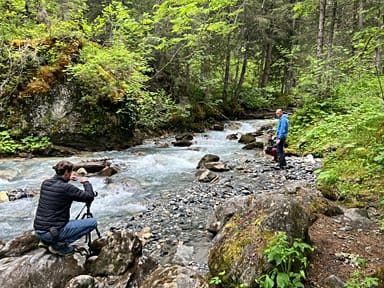
The Contamines-Montjoie Nature Reserve, near the French side of Mont Blanc, is one of pilot sites of the transnational Waterwise project, which aims to model how alpine water resources will evolve under different climate scenarios and the various pressures that will affect these ecosystems in the future.
At its heart, the project aims to bridge the gap between scientists and local communities to jointly build sustainable water strategies.
“We only protect what we know. This project aims to increase knowledge, and therefore increase protection,” says Geoffrey Garcel, the reserve’s warden, who hiked up to the Plan Jovet, where two lakes sit near a vanished glacier. Like many headwater catchments, it is a hard-to-reach area, where collecting data on the state of the water can be difficult.
“We focus on headwater catchments because they are areas that will be highly vulnerable in the context of climate change. And also because everything that happens upstream will affect what happens downstream.”
Solène Pignard
Waterwise Research Officer, Réserves Naturelles de France
Waterwise aims to bring together a large body of existing information and to find missing data through field surveys and the installation of lightweight sensors known as “smart rocks”, placed inside the watercourses. The data gathered includes information on water quantity, ecological status or temperature. This information is cross-referenced with socio-economic data such as farming, energy production and tourism.
The Contamines-Montjoie Reserve for instance, is crossed each year by thousands of hikers walking the famous “Tour du Mont Blanc.” In summer, herds of cows graze along the mountain streams. French energy company EDF takes some of the water to supply a power plant in the neighboring valley. These pressures have led the reserve to adopt adaptation measures in recent years.
“If we compare different catchments in different countries, we can maybe identify some common patterns, and develop sustainable solutions that can then be transferred to other regions in the Alps.”
Markus Noack
Professor of hydraulic engineering and water resources management at Karlsruhe University of Applied Sciences
The data collected through Waterwise will also be used to feed an open-access “digital toolbox”, which can help decision-makers and stakeholders from alpine communities jointly discuss the adaptation measures needed to ensure the resilience of their territories. Drawing on the mountain-territory stakeholders’ knowledge is another important strand of Waterwise.
With a total budget of €2.69 million, the Waterwise project is co-funded with €1.61 million from the European Regional Development Fund (ERDF). It brings together 12 partners from France, Germany, Switzerland, Austria and Slovenia.



 News
News
 Dünya
Dünya
 Dünya
Dünya
 Dünya
Dünya
 Dünya
Dünya
 Dünya
Dünya
 Dünya
Dünya