DOLAR

46,2708$% 0.14

EURO

53,5883% -0.13

GRAM ALTIN

6.266,66%0,15

ÇEYREK ALTIN

10.362,00%-0,16

ONS

4.208,87%-0,09

BİST100

14.098,75%2,58

BİTCOİN

2943449฿%1.10092

a
Güncellenme - Nisan 5, 2026 17:08
Yayınlanma - Nisan 5, 2026 17:08

Easter Rising commemorations take place in Dublin and Belfast

A wreath was laid by the Irish President Catherine Connolly at the General Post Office (GPO) in the Irish capital

Commemorations have taken place across the island of Ireland on the 110th anniversary of the Easter Rising.

The 1916 rebellion was an attempt to overthrow British rule in Ireland and has been credited by many historians as paving the way towards an independent Irish republic.

A wreath was laid by the Irish President Catherine Connolly at the General Post Office (GPO) in Dublin.

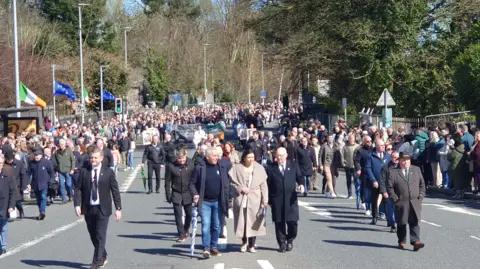
In Belfast thousands of people turned out for a parade in the west of the city.

Thousands attended a parade in the west Belfast

Crowds lined the Falls Road as bands made their way into Milltown Cemetery.

Also attending the event in Dublin was Northern Ireland’s First Minister Michelle O’Neill and the Irish Taoiseach (Prime Minister) Micheál Martin.

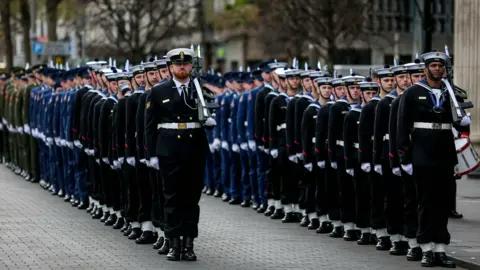
More than 200 members of the Irish Defence Forces took part in the proceedings in Dublin

More than 200 members of the Irish Defence Forces took part in the proceedings in Dublin and the proclamation was read by Capt Eva Houlihan almost 110 years after it was read by Pádraig Pearse in the same location.

The commemoration was also attended by Tánaiste (deputy Prime Minister) Simon Harris, Minister for Defence Helen McEntee, Lord Mayor of Dublin Ray McAdam and Sinn Féin leader Mary Lou McDonald.

Speaking at Arbour Hill Cemetery – the burial site of the 14 leaders of the rising – McDonald said that as the 30th anniversary of The Good Friday Agreement approaches, “we have secured the peace. Now is the time to write the next chapter of our national story – the reunification of Ireland”.

“This is the decade when Irish unity can be won – decided by people north and south in referendums,” said McDonald, who is the Leader of the Opposition in the Dáil (Irish parliament).

“The conversation is underway, but conversation alone is not enough. We need vision, determination, and leadership. We need action.”

What was the Easter Rising?

The Easter Rising was a rebellion designed to overthrow British rule in Ireland.

It was organised and carried out by members of the Irish Republican Brotherhood, the Irish Citizen Army, and Cumann na mBan, or the ‘League of Women’.

Shortly after noon on Easter Monday 1916, Pádraig Pearse accompanied by an armed guard, stood on the steps of the GPO and read a proclamation declaring the establishment of an Irish republic, signalling the beginning of the Easter Rising.

The conflict that followed was largely confined to Dublin.

The Easter Rising was quelled within six days by British troops, but despite its failure it is seen as a significant stepping stone to the eventual creation of the Republic of Ireland and the partition of Ireland.

More than 450 people were killed and 2,500 injured during the fighting.

In the aftermath of their surrender to British troops in 1916, 14 rebel leaders were executed by firing squad in the stonebreakers’ yard at Kilmainham Gaol.

Two other rebel leaders were executed elsewhere – Thomas Kent was shot dead by firing squad in Cork and Roger Casement was hanged at Pentonville Gaol in London.

The manner of their deaths is seen by many historians as instrumental in changing public opinion in Ireland in 1916 – which was initially hostile to the rebellion – into sympathy and support for the republican push for independence.

Belfast
Republic of Ireland
Dublin
Michelle O’Neill
Northern Ireland
0 0 0 0 0 0
YORUMLAR

s

En az 10 karakter gerekli

HIZLI YORUM YAP

0 0 0 0 0 0