DOLAR

43,4966$% 0.02

EURO

51,4054% 0.12

GRAM ALTIN

6.667,46%2,55

ÇEYREK ALTIN

11.581,00%2,24

ONS

4.773,21%2,61

BİST100

13.620,95%-1,57

BİTCOİN

3390294฿%1.96351

a
Güncellenme - Şubat 3, 2026 03:40
Yayınlanma - Şubat 3, 2026 03:40

Door is open to customs union talks with UK, EU says

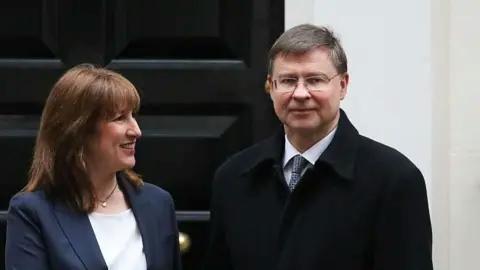
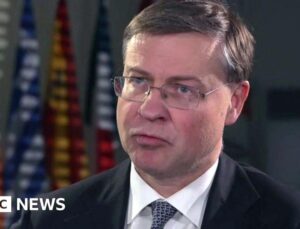
Valdis Dombrovskis spoke to the BBC following a meeting with the chancellor and two cabinet ministers on Monday

Brussels would be “open‑minded” about discussing closer trade ties with the UK, including the possibility of working together on a customs union, the European Commissioner for finance has told the BBC.

Valdis Dombrovskis said the bloc was “ready to engage” if the UK wanted to explore the move, an idea Labour has faced growing pressure to consider.

Speaking after high-level talks with ministers including Chancellor Rachel Reeves, he also said Britain and the EU could remove “most” food checks between the UK and the bloc.

He also opened the door to Britain entering the EU’s €150bn ($177bn; £130bn) defence loans scheme after talks on an agreement broke down last year.

Dombrovskis’s intervention marked the strongest comments yet from Brussels about its willingness to re-engage with Britain amid mounting global uncertainty.

At an event with Dombrovskis in London on Monday, Reeves argued stronger ties are increasingly important as “we are sliding towards a world where the rules are less clear”.

A customs union would eliminate tariffs or taxes on some or all goods between the UK and the EU, reducing bureaucracy.

But critics point out that it would also severely curtail the UK’s ability to strike bespoke global trade deals, as the EU would place a common tariff on all goods from outside the customs union area and would expect the UK to conform to common standards.

Labour’s election manifesto ruled out signing up to the existing EU customs union.

The party also said it would not rejoin the EU’s single market, where countries adopt common laws in some areas to make it easier to trade goods and services.

Calls for a customs union with the EU have been growing among Labour MPs, while Justice Secretary David Lammy said one could boost economic growth.

Asked by the BBC whether Brussels would welcome talks on Britain rejoining the customs union, Dombrovskis said: “I cannot jump to conclusions, but I can say that we are ready to engage with an open mind and seek those areas of cooperation.”

He said it was unlikely Britain will return to the single market, stressing that access would require the UK accepting freedom of movement.

The single market relies on a country accepting “the four freedoms”: freedom of movement, goods, services and capital.

Chancellor Rachel Reeves told EU Commissioner Valdis Dombrovskis: “We are sliding towards a world where the rules are less clear”

Reeves hosted Dombrovskis and European Commissioner for Trade Maroš Šefčovič, alongside cabinet ministers Peter Kyle and Nick Thomas Symonds.

The group – dubbed the “Quint” by diplomats – aims to meet regularly to coordinate responses to the drastic changes to the trade and economic environment in recent months.

While the group will not formally negotiate a Brexit reset, its existence signals a desire on both sides to cooperate given global uncertainty.

At the meeting, Reeves told the group the UK and EU “share values and objectives when it comes to the economy, to trade, and to security”.

She also emphasised the “need to work together and as far as possible speak with one voice”.

Labour has already struck several side deals with the EU, including a major agreement on food standards which is yet to be finalised.

Dombrovskis said that, once in place, it could end almost all checks on goods moving between Britain and the EU – something which has led to chaos for firms trading across the border – provided the UK aligns with EU sanitary and phytosanitary rules.

He also said talks on a youth mobility scheme were “very advanced”.

But one area in which progress has stalled is Britain’s participation in the Security Action for Europe (SAFE) scheme, a massive programme of borrowing to help EU countries buy defence equipment.

British companies would currently be limited to supplying 35% of the total value of a finished defence product, and talks over an enhanced deal broke down in November.

Asked whether he would consider a new agreement, Dombrovskis said: “We are open for further discussions, we know the prime minister has expressed interest, actually, to come back to this issue, and there is certainly openness from the EU side for this.”

The meetings come after a tumultuous period for international relations, which saw US President Donald Trump threaten to take control of Greenland from Denmark and impose fresh tariffs on Nato allies.

In response, the European Commission threatened to levy retaliatory tariffs on the US, with Trump eventually backing down and agreeing a deal to bolster the security of Greenland without compromising its sovereignty.

Dombrovskis said Brussels’ decision to stand firm against Trump’s threats was key to shift the discussion to “a more productive” place.

“That was clearly unacceptable, and we made it very clear from EU side, also indicating that we are ready to take counter measures if necessary,” he added.

EU-UK post-Brexit trade deal
Brexit
0 0 0 0 0 0
YORUMLAR

s

En az 10 karakter gerekli

HIZLI YORUM YAP

0 0 0 0 0 0