DOLAR

43,4990$% 0.19

EURO

51,6240% -0.9

GRAM ALTIN

6.786,60%-9,85

ÇEYREK ALTIN

11.838,00%-7,58

ONS

4.848,73%-10,11

BİST100

13.838,29%0,05

BİTCOİN

3600906฿%0.09725

a
  • Objektif Media
  • Dünya
  • One wrong move and it could all go wrong – the men clearing deadly undersea Russian mines
Güncellenme - Ocak 31, 2026 04:08
Yayınlanma - Ocak 31, 2026 04:08

One wrong move and it could all go wrong – the men clearing deadly undersea Russian mines

The Black Sea is littered with deadly weapons. But no-one knows how many – or where they are.

“When we approach it, we should be quiet, we should be slow – and we should be very accurate,” says Vitalii, wiggling his hand in a snake-like motion, as he describes swimming through dark waters towards the explosive devices resting on the sea floor.

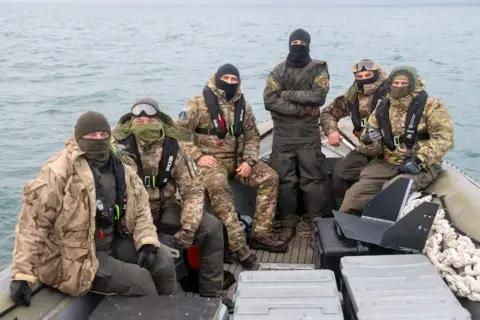
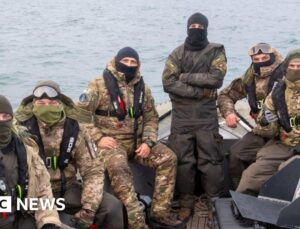
The tall, softly spoken 31-year-old Ukrainian Navy diver is part of a team of 20 tasked with de-mining the parts of the Black Sea still under Ukraine’s control.

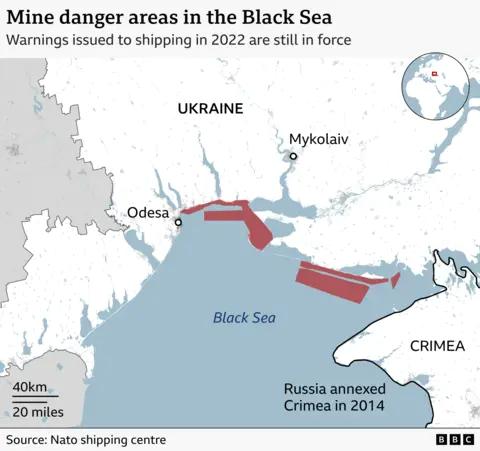
Mines are some of the most insidious and long-lasting legacies of war. They remain active, and deadly, for decades; the ones at sea present additional risks, as they can drift with currents and storms.

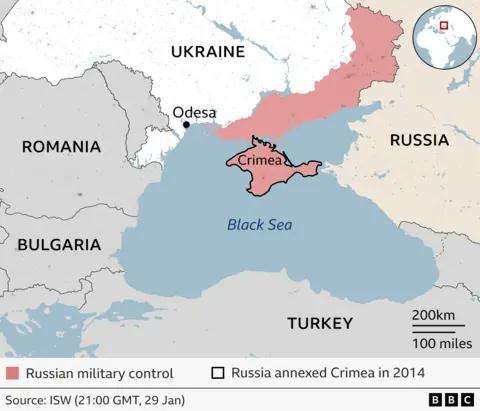
The sea mines laid by Moscow at the start of the full-scale invasion – when Russian ships approached Odesa – are no different. And the danger is not theoretical: last summer, three swimmers were killed by mines off the Odesa coast.

The commander of the navy’s mine countermeasures group – a wry, sharp-eyed young man who goes by the callsign Fox – estimates the number of sea mines is in the thousands.

But they are not the only danger lurking underwater. Missiles, artillery shells, bombs and land mines were washed downstream to the sea when the Kakhovka dam was blown up in 2022. These too could be triggered to explode at any minute.

“If we speak about unexploded ordnance in general – missiles, artillery shells, aerial bombs – the total number will be many times higher” than several thousand, Fox says.

His team’s work is as perilous as it is vital.

Despite the scale of the contamination, sea traffic has not come to a halt, and a significant number of merchant ships are still operating in the only maritime export corridor out of Ukraine.

For Ukraine, the effort to clear the seabed is part of a broader attempt to keep the ports on the Black Sea usable, particularly by commercial ships that bring in a stream of much-needed revenue.

Aided by a huge army, on the front line Moscow manages to just about hold the upper hand, but at sea, Ukraine has succeeded in evening out the playing field.

Sitting in a café overlooking the Gulf of Odesa, navy spokesman Dmytro Pletenchuk gestures towards the expanse of sea beyond the window.

“There is parity in the maritime domain at the moment,” he says.

“We find new ways to strike them; they look for ways to counter us. What works today will not work tomorrow – on both sides. They adopt our experience; we adopt theirs.”

Ukrainian ships cannot move further than the area surrounding Odesa due to Russian control of much of the coast.

Removing a mine takes two days, several boats, and the work of 20 people

And Moscow has too seemingly reached the conclusion that moving ships out of many of its naval bases in the Black Sea is too big a risk, as they would be within reach of Ukrainian aerial strikes.

In 2024, Russia withdrew its last remaining patrol ship from occupied Crimea.

“While Russia may have an advantage on land and in the air, it does not at sea,” he adds.

“Here, Russia’s main tactic – mass – does not work.”

“Naval warfare is technological. You cannot overwhelm an area with ‘meat’,” Pletenchuk says, using the term to refer to the sheer number of soldiers at Russia’s disposal.

The stalemate at sea has allowed Ukraine’s sea exports to continue, and a so-called grain corridor to remain operational.

Maritime exports account for over two-thirds of Ukrainian agricultural exports, which some reports say add up to roughly $9bn. It is an essential source of revenue for Ukraine.

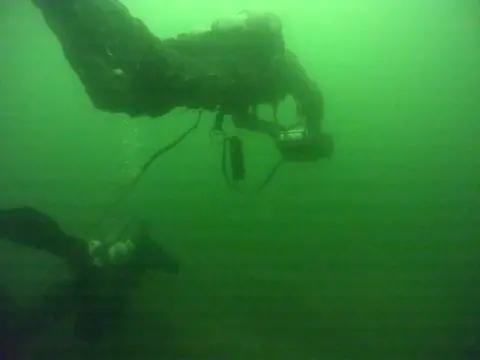
Divers move slowly towards the mine one second at a time, then wait three more

Although aerial attacks remain a regular reality, vessels continue to navigate in the area.

“Judging by the fact that vessel traffic has not decreased, [commercial companies] are willing to take these risks,” Pletenchuk says, pointing to two large ships cruising silently on the horizon.

Now, keeping the shipping routes viable also depends on removing the threat beneath the surface.

Mines and unexploded ordnance are still a passive tool Russia can use to disrupt maritime traffic, even without controlling the Black Sea itself.

That is where divers like Vitalii come in.

“We move carefully and extremely slowly so that the mine does not detonate,” Vitalii says, describing the painstakingly slow process of demining. “One second you move, then you stay still for some time, and you repeat this until you reach the object.

“Generally, it’s up to 20 meters before [we reach] the object, so you can try to imagine how long it takes to approach it.”

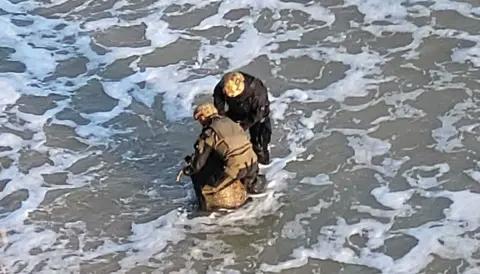
Two members of the team bring the mine to shore

But before the underwater de-mining mission can even begin, Vitalii’s group needs to identify the object, as missiles and a wealth of World War Two unexploded bombs sit on the seabed alongside Russian sea mines.

Commander Fox explains that mines generally fall into two categories: contact mines, which detonate when struck, and influence mines, which explode when sensors detect changes in sound, pressure or magnetism.

“Usually, the acoustic sensor is on duty,” he says. “If it hears noise, it can activate another sensor.”

Large commercial ships are particularly vulnerable to magnetic mines, which respond to changes in the magnetic field. “The mine lies on the bottom and explodes when a big vessel approaches,” says Fox, mimicking two magnets snapping together. “Until that moment, it just waits.”

Two divers approach each device in total silence, using closed-circuit rebreathers that produce no bubbles. Once a mine is identified, the actual detonation often takes place the following day.

The sensors, Vitalii says, are first disabled using a series of controlled explosions with the first done from about 10 meters away. Only then can divers approach the device itself. The final decision – whether to move the mine or destroy it in place – is taken by headquarters.

This surgical operation takes two days, several boats, and the work of 20 people – all operating under the constant threat of Russian missiles and drones, both aerial and seaborne, which could easily trigger the mines.

During air strikes, GPS signals are scrambled, making sonar readings imprecise.

De-mining the sea is not impossible, but doing so in the middle of active combat ramps up the risk considerably. “Everything can go wrong”, Fox says.

Vitalii nods. Once, he recalls, as he was approaching a mine using sonar, another object appeared on his screen, moving slowly through the darkness.

His first thought was that it could be a Russian underwater drone, and that the mine would detonate. Then, he turned and saw four or five dolphins swimming past.

“Beautiful, yes,” he says, his eyes widening. “But not at that moment.”

According to Pletenchuk, in 2025 the de-mining group neutralised more than 50 mines – a fraction of the total.

In 2023 the British Navy gifted Ukraine two mine-hunting vessels that could speed the work up – but because large ships in the Black Sea are an easy target, they are still stationed in the UK and won’t be deployed until a ceasefire has been agreed. Two years after the vessels were handed over, that possibility still seems remote.

In the current conditions, Vitalii says, clearing the seabed will take dozens of years.

Despite the risks, revenue from maritime exports will only grow more essential for Ukraine the longer the war continues. And so divers like Vitalii will keep going back into the water – moving one second at a time, then waiting three more.

Europe
War in Ukraine
Russia
Ukraine
0 0 0 0 0 0
YORUMLAR

s

En az 10 karakter gerekli

HIZLI YORUM YAP

0 0 0 0 0 0